



Rooms available for wild bees and other insects
They are small, quiet and usually inconspicuous, yet their contribution to life as we know it is enormous. Wild bees, bumblebees, digger wasps and many other insects belong to the so-called Hymenoptera, one of the most species-rich groups of insects in Central Europe. As pollinators, they not only ensure plant diversity but also control pests. Yet many of these species can hardly find suitable habitats in our cities anymore. Modern building facades often lack the small cracks and crevices that used to serve as nesting sites. Rotten trees, dead branches or old fence posts have also become rare in built-up areas. The loss of such natural structures is a factor in many of these beneficial insects now being on the Red List.
A simple and effective measure to protect these creatures is the provision of nesting aids for insects. These can be made from natural and carefully selected materials such as hardwood with smooth drill holes, small tubes of reed or bamboo, filled clay bricks or loose sand, and offer a variety of small spaces for different species. What matters is not the size, but the quality and variety of nesting options. Each species has its own requirements regarding shape and material. For instance, wild bees require specific tube diameters for egg-laying, whilst solitary wasps prefer to nest in sandy tubes. One example of such an inhabitant is the steel-blue mason bee (Osmia caerulescens). It is found in structurally diverse landscapes as well as in cities, provided it can find sufficient flowers and suitable tubes for nesting.
On the University of Graz campus, such insect hotels are specifically placed where they are most useful. The locations are sunny, sheltered from the wind and situated near areas rich in flowers. This is because without a sufficient supply of native flowering plants that provide food from early spring through to late summer, even the best nesting aid remains unused. Early-flowering plants play a particularly important role here, as many wild bee species are already active in March. What at first glance looks like a simple wooden box thus becomes an entire micro-ecosystem making a valuable contribution to biodiversity.

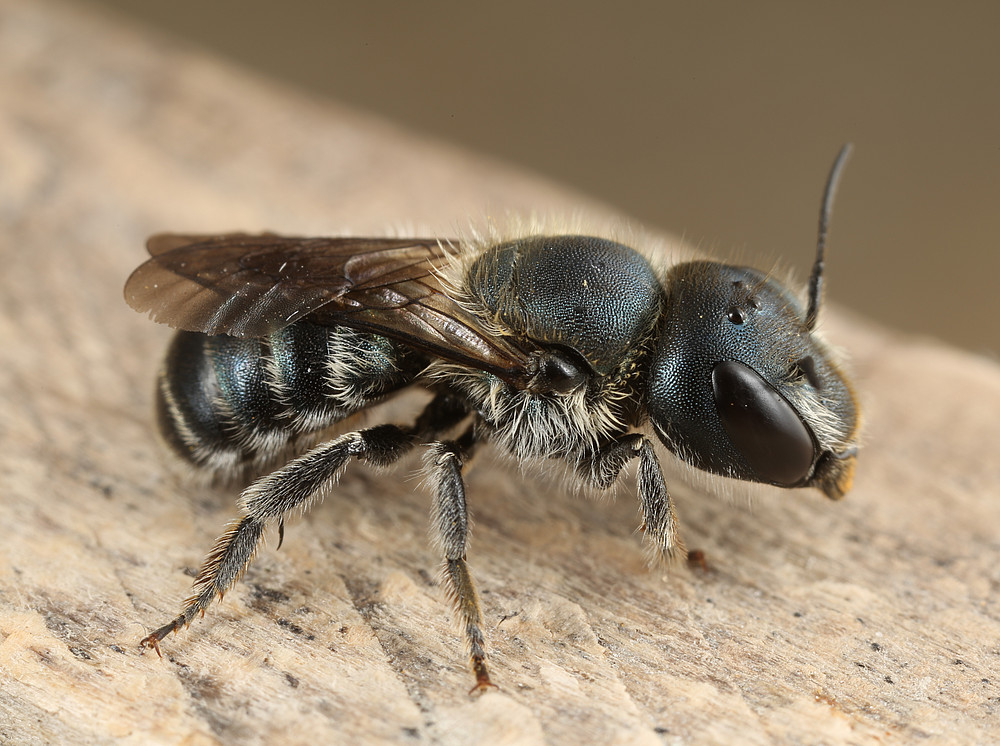
Target species:
Steel-blue mason bee
The steel-blue mason bee (Osmia caerulescens) is found on the edges of woodlands, in orchard meadows, in structurally diverse agricultural landscapes and in urban environments, provided there are suitable nesting sites and a food supply. In Graz, it is known to inhabit the Botanical Garden, amongst other places. It requires linear cavities approximately 4–5 mm in diameter for nesting. It finds these, for example, in deadwood, dry stone walls, plant stems, loess and even house walls. Artificial nesting aids are particularly good alternatives for this species in urban areas. It readily colonises bamboo canes and reeds, builds several brood cells within the canes and uses chewed plant parts to seal the entrances. This species is ‘polylectic’, meaning it feeds on a wide range of pollen. It therefore requires a food supply rich in flowers, with papilionaceous and Lamiaceae plants, as well as Asteraceae, being particularly attractive to it. Wild bees in general, and this species in particular, can be supported through the proper provision of nesting sites and flower-rich meadow areas. The flight period is roughly May to July, with a second generation extending into August.