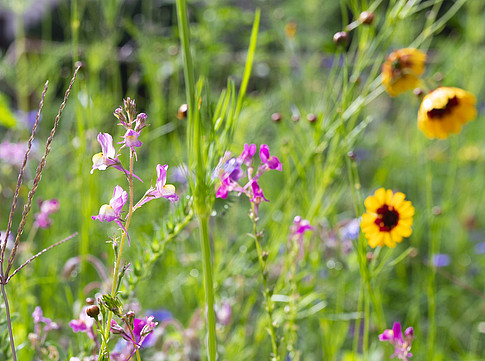
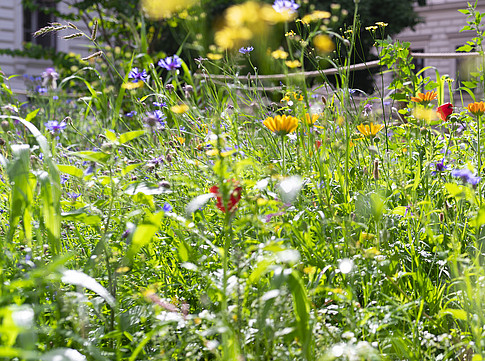
A colourful mix to bring more life to the campus
They are colourful, vibrant and ecologically valuable: wildflower meadows are a key component of the University of Graz’s biodiversity strategy. But it is not just about beautiful colours or bringing a sense of nature into everyday life. Flowering meadows provide exactly what is lacking in many urban areas today. They offer habitats for wild bees, butterflies, beetles, grasshoppers and many other species that depend on species-rich, flowering areas.
Especially in a city like Graz, where many green spaces are intensively maintained or sealed, flowering meadows can make a big difference. The University of Graz has therefore set itself the goal of specifically enhancing existing meadow areas on campus ecologically and creating new flowering areas.
What makes flowering meadows special is their diversity – in terms of colours, structures, species and ecological functions. They provide food and nesting sites for a wide variety of insects, promote soil life, support natural pollination and improve the microclimate. Many rare or endangered species can only establish themselves if such species-rich meadows are restored.
The conversion of lawns into flowering meadows is not a one-off intervention, but a long-term process. First, we assess which areas are suitable. The potential for an ecologically valuable flowering meadow is particularly high where the soil is nutrient-poor or can be unsealed. We then use regional, site-appropriate seeds to promote the development of native plant diversity. Maintenance is adapted accordingly: mowing is carried out less frequently but in a targeted manner, usually once or twice a year, so that the desired species can establish themselves and the areas remain stable in the long term.
At the University of Graz, flowering areas are also used as learning spaces: for teaching, research and raising awareness. They encourage people to look more closely and highlight how important small-scale habitats can be within a larger ecological context.
In combination with other measures such as insect hotels, sandariums, deadwood areas or beetle castles, flowering meadows are a key element of the Green Corridor, which the University of Graz aims to strengthen as part of its biodiversity strategy. Because every area counts, especially when it is properly designed and maintained in the long term.